
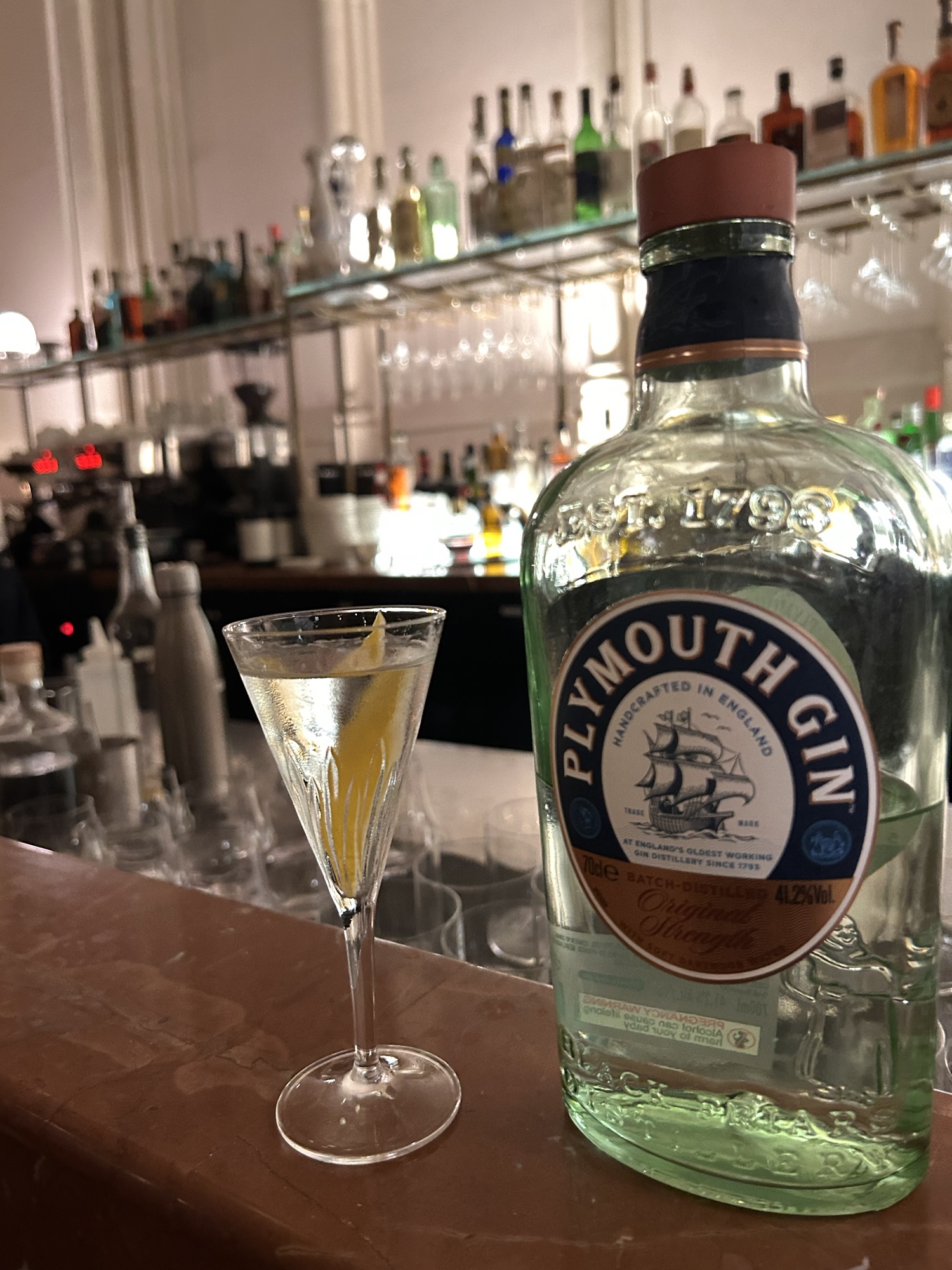
I get asked all the time what my favourite Martini gin is, and this has to be it friends. I like its subtlety, balance and its clean finish. There is always a bottle in my freezer (served with a hint of Dolin Dry Vermouth and a lemon peel garnish.
So it was a real thrill to be converse with the venerable distillery’s master distiller recently virtually.

Plymouth Gin’s master distiller keeps a 200-year-old recipe steady
When Sean Harrison started at Plymouth Gin in 1994, there were twelve gin distilleries in Britain making twenty gins between them. Today there are somewhere between five and a half and seven thousand gin brands worldwide. Harrison has watched that whole expansion from inside one of the oldest brands in the category, and he describes his role in plain terms: he is the custodian of the recipe, and when he retires, someone else will take it over.
His path there was an odd one. His last posting in the Royal Navy was in Plymouth, one of the Navy’s major ports. In his final nine months he met his future wife, and the assistant manager’s job at the distillery turned up in the local paper, which in those days was where jobs appeared. He posted his CV that Friday morning without expecting much. He considers his timing excellent, since he arrived just before gin became a category people argued about.

The recipe stays fixed while the plants don’t
Plymouth’s recipe is the same as it was two centuries ago. The crop it is made from is not. Harrison borrows the French word terroir for it: the soil, the sun, the rain and the hillside all change how a plant builds its essential oils, and gin is made by extracting exactly those oils. Every harvest comes in slightly different.
The distillery’s job is to hide that variation from the drinker. That means selecting botanicals carefully, and blending distillations in a large vat so no single run stands out. Even so, he says, a bottle from ten years ago will taste subtly different from one today.
This makes the supplier relationship central to the work. Plymouth buys from about six suppliers in the UK and Europe, and Harrison had spoken to two of them in the week of the interview. Coriander season was about to start, followed straight away by juniper. A dry year or a wet year shows up in the cost and quality of what arrives, as with any crop.
The equipment is nearly as old as the recipe. The still is from the early twentieth century, and Harrison has a photograph of it from 1906. What has improved is the spirit going into it. Pot stills top out around 85 percent alcohol. The continuous still, invented in the late 1800s, reaches about 96 percent, and that last stretch strips out impurities that would otherwise have muddied the gin.
The recipe is exactly the same, but the technology behind the making process has got better.

Seven botanicals, none of them dominant
Juniper is Plymouth’s largest ingredient, but only just. The other six follow in close ratios, so no single flavor leads. Harrison says that is why the gin works in so many drinks: nothing in it is fighting the other ingredients.
He goes further than most distillers would and says Plymouth is the best martini gin on the planet. He argues the drink is made or broken by the vermouth, and compares it to making a cup of tea, where everyone has their own version. Olive or olive brine, twist or no twist, Gibson or not: two ingredients, a million directions. His own habit is to skip the garnish entirely.
He is specific about strength, too.
A martini should start at 41.2 percent, because stirring dilutes it down to the high twenties, the point where the alcohol’s bite fades and the gin’s aromas come through.
Shaking removes that control, and a 57 percent gin would take far longer to stir down to the same place.
Why Navy Strength exists
The higher-strength bottling is a better fit for stronger company. Because alcohol carries flavor, a higher-proof gin keeps its character against sweet vermouth, which is why Harrison recommends Navy Strength for a Negroni.
The name has a story behind it. Before alcohol could be measured by specific gravity, the only test was to mix a spirit with gunpowder and set it alight. If the powder ignited, the spirit was above what was deemed 100 proof, which in the English system works out to 57.14 percent ABV. Early Plymouth Gin in 1793 would have been close to that.
The strength fell out of fashion.
For the brand’s 200th anniversary in 1993, Plymouth bottled a batch at 100 proof, but by the mid-nineties the term meant little to most drinkers. In 1996, after a management buyout, the team wanted to keep it going and needed a new name. One of the owners, John Murphy, who had started the branding firm Interbrand, came up with Navy Strength.
Sloe gin, and where it came from
Harrison is candid that the history of sloe gin has largely been lost, and says he is piecing it together from fragments. The best account points to the Enclosure Acts of the 1700s, when common land was divided into fields and blackthorn was planted as hedgerow. The fruit of the blackthorn, the sloe, is a very sour plum. Someone discovered that soaking it in gin with a lot of sugar made something good.
Plymouth has made its own for about twenty-five years, and supplied the gin for the older Hawker’s sloe gin, a Plymouth label whose roots go back to around 1800. At 26 percent it drinks well neat, works in a sloe gin fizz, and stands in for port with cheese after dinner.

Sustainability, and its limits
Plymouth has been working on its environmental footprint for about fifteen years. The distillery’s electricity has long been hydro. About a year before the interview it replaced its gas boiler with an electric one, which makes production of the gin fossil-fuel free. Packaging is recycled, and the bottle has been lightened and carries a high share of recycled glass.
Harrison is frank about what remains unsolved. Making glass takes a great deal of energy, so the distillery is looking for suppliers who are changing how they produce it. It also supports a local ocean trust, about two hundred meters from the distillery, that is restoring seagrass in Plymouth Sound, the harbor in front of the town.
- Website: https://plymouthdistillery.com
- Instagram: https://www.instagram.com/plymouthgin
- My conversation with Sean on YouTube here


Leave a Reply